Introduction
The Changing Landscape of Digital Fraud
In the modern digital economy, almost every financial transaction, from online shopping to money transfers, occurs in a fraction of a second. While this speed has brought immense convenience, it has also created a fertile ground for fraudsters. Cybercriminals now use advanced tools to manipulate systems, steal identities, and exploit vulnerabilities faster than traditional fraud detection methods can respond. For decades, companies relied on manual checks or simple rule-based systems to identify fraud. However, with the explosion of data and the increasing sophistication of cyber threats, these methods have become outdated. This growing challenge gave rise to Artificial Intelligence (AI), which has revolutionised how businesses detect and prevent fraud, not after it happens, but in real-time.
At Aidify Learning and Mobility, we leverage the power of AI to transform fraud prevention into an intelligent, adaptive, and predictive system that continuously evolves with every new threat

1. The Evolution of Fraud Detection: From Rules to Intelligence
In the early days of digital transactions, fraud detection was primarily manual and rule-based. Banks and financial institutions set up static rules such as flagging transactions above a certain amount or blocking activity from unusual locations. While this method worked for predictable fraud patterns, it was rigid and reactive. Fraudsters quickly learned how to bypass these systems by operating just below the detection thresholds or using stolen credentials that appeared legitimate. As technology evolved, so did the complexity of fraud. The volume of digital transactions increased exponentially, making manual reviews impossible. Businesses started collecting massive amounts of data from various sources, including device information, geolocation, and transaction history. However, the challenge was no longer collecting data; it was analysing it fast enough to spot irregularities. This is where machine learning entered the picture. Machine learning allowed computers to learn from historical data, both fraudulent and legitimate, to identify subtle and complex patterns that humans or static systems could never detect. This marked the beginning of a shift from reactive defence to proactive, data-driven fraud prevention.
Today, Aidify Learning and Mobility continues this evolution, building AI-driven systems that adapt, learn, and protect users at every digital touchpoint.
How AI Detects Fraud in Real-Time
AI Aidify continuously monitors thousands of transactions every second, identifying unusual patterns the moment they occur. By comparing behaviour, device usage, and location signals, the system instantly spots activity that doesn’t match a user’s normal profile. It uses multi-source datalike login habits, device fingerprints, and network clues to build a highly accurate risk score for every action. When something looks suspicious, the AI engine reacts within milliseconds, blocking or verifying the activity before any damage is done. This ensures seamless protection where genuine users stay unaffected while fraud attempts are stopped instantly.
- Data Collection
- Pattern Learning
- Real-Time Decisioning
3. The Core AI Technologies Behind Fraud Detection
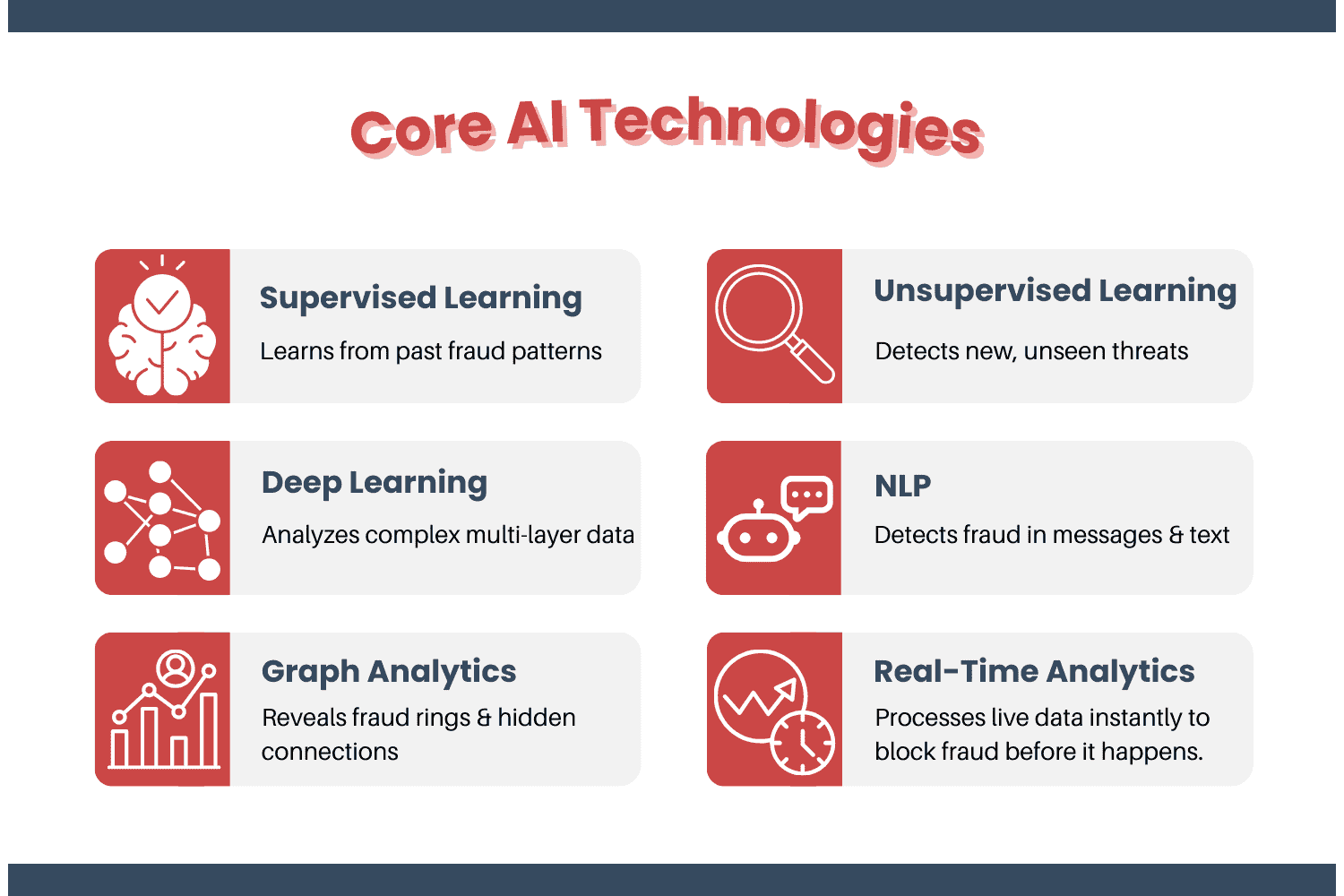
AI-driven fraud detection uses several advanced technologies working together seamlessly. The foundation lies in supervised learning, where the model is trained on vast datasets containing examples of both legitimate and fraudulent transactions. Over time, it learns to differentiate between the two, identifying even the smallest indicators of fraud. On the other hand, unsupervised learning comes into play when the AI encounters new, previously unseen patterns. It doesn’t rely on labelled data; instead, it detects anomalies, transactions or behaviours that deviate significantly from established norms, which often signal emerging fraud techniques.
Another critical component is deep learning, a subset of AI that mimics the human brain’s ability to process complex relationships. Deep learning models can analyse data from multiple layers, such as transaction time, device behaviour, and customer profile, to arrive at a holistic risk assessment. In addition, natural language processing (NLP) helps detect fraud hidden in text-based data like emails, chat messages, or customer reviews. NLP can identify phishing attempts, fake identities, or false claims by analysing the tone, phrasing, and structure of written communication. Meanwhile, graph analytics maps relationships between people, devices, and transactions. This technique exposes organised fraud rings or collusion networks that operate across multiple platforms.
All these technologies are integrated within Aidify Learning and Mobility, empowering businesses with a smarter, faster, and more transparent fraud defence framework.
4. Why Real-Time Detection Matters
Traditional fraud detection often happens after the damage is done, once a suspicious transaction has already occurred. AI changes this by enabling real-time detection, meaning fraudulent activity is stopped before it can cause harm. This capability is essential in a world where thousands of transactions take place every second.
By analysing data streams in real-time, AI systems can instantly detect inconsistencies, alert the relevant teams, and take action without disrupting genuine users. For businesses, this means reduced financial losses, fewer false positives, and a better customer experience.
Furthermore, AI’s ability to adapt to new data ensures continuous improvement. Every time a new type of fraud is detected, the model learns from it, making the system smarter with each iteration. This ongoing learning process helps businesses stay ahead of cybercriminals a core mission of Aidify Learning and Mobility.
5. Industry Applications of AI Fraud Detection
AI fraud detection is not limited to banks or financial services; it spans across industries.
- Banking and Fintech: AI monitors credit card transactions, loan applications, and wire transfers to identify suspicious behaviour in seconds.
- E-Commerce: It detects fake accounts, payment fraud, and refund abuse, protecting both sellers and buyers.
- Insurance: AI analyses claims to spot inconsistencies that suggest false submissions.
- Telecommunications: It prevents SIM swap fraud, fake identity registrations, and data misuse.
- Healthcare: AI detects fraudulent billing, unauthorised data access, and insurance misuse.
At Aidify Learning and Mobility, we tailor our AI models for each industry, ensuring precision, transparency, and compliance across all fraud prevention use cases.
6. How We Do AI Fraud Detection in Real Time with AI Aidify
At AI Aidify, we’ve built a next-generation fraud detection system that not just watches, it learns, predicts, and acts instantly. Our AI engine continuously monitors every transaction and activity across platforms, ensuring threats are caught the moment they happen. Here’s exactly how we do it, powered by Aidify Learning and Mobility
1.
Collect and Understand Data Deeply
We start by collecting massive amounts of structured and behavioural data like transaction amounts, locations, device fingerprints, and user interaction patterns. We do this to establish a baseline of what “normal” behaviour looks like for each user.
Example: If a user typically logs in from Pune using an Android device, but suddenly logs in from Russia using a MacBook, our AI instantly recognises this as a high-risk deviation and triggers a security check before the transaction continues.
2.
Use Machine Learning to Learn User Behaviour
Our machine learning models analyse months (or even years) of user activity to recognise patterns. We do this to teach the AI what legitimate user behaviour looks like and what doesn’t.
Example: Suppose a customer usually makes small online purchases of ₹1,000 – ₹2,000 but suddenly tries to transfer ₹80,000 at 2 AM. The system instantly detects this as suspicious and pauses the payment, preventing possible account compromise.
3.
Detect Anomalies in Real-Time
Our AI operates continuously, analysing data streams as they happen. We do this to identify unusual or out-of-pattern activity within milliseconds.
Example: If a credit card is used twice within five minutes, once in Mumbai and once in Delhi, AI Aidify’s system detects the geographic inconsistency. It automatically blocks the second transaction before it completes.
4.
Connect the Dots Between Accounts and Devices
Fraudsters often create multiple fake accounts or use shared devices to avoid detection. We do this through graph analytics, which helps AI Aidify identify hidden relationships among users, devices, and payment methods.
Example: If five new accounts are registered using the same phone number or device, our system links them together, detects the pattern, and flags the accounts as part of a potential fraud network.
5.
Automate Smart Decision-Making
Detection isn’t enough speed matters. We do this by letting our AI decision engine take instant, intelligent actions based on risk scores.
Example: When a suspicious login attempt occurs, our system may automatically request OTP verification or temporarily freeze the account. This allows genuine users to verify themselves while blocking bad actors instantly.
6.
Continuously Learn and Improve
Fraud tactics evolve daily, and so do we. We do this by feeding every confirmed fraud case back into our AI models, allowing them to adapt and predict new attack methods.
Example: When fraudsters started using VPNs to disguise their locations, our models learned to analyse deeper network data like device IDs and browser signatures, quickly identifying fraudulent logins even through VPNs.
7.
Apply AI Across Real Business Scenarios
AI Aidify is designed to protect businesses across multiple industries. We do this by tailoring our models for each use case, from fintech to e-commerce and telecom.
Example:
- For fintech, we detect unauthorised fund transfers in real time.
- For e-commerce, we identify fake refund requests using behavioural tracking.
- For telecom, we detect SIM swap attempts before they affect customers.
In one real case, an e-commerce client reduced refund fraud by 60% in just three months using our adaptive behavioural AI.
8.
Deliver Instant Insights and Transparent Reporting
Fraud detection must be intelligent and explainable. We do this by using Explainable AI (XAI) dashboards that provide real-time insights into suspicious activity and the logic behind each flag.
Example: When a transaction is blocked, our dashboard shows the exact reason, such as “Unusual location + new device + high-value transfer” so security teams can take confident, data-backed decisions.

7. The Future of Fraud Detection: Smarter and More Transparent
The future of AI fraud detection is shifting towards adaptive intelligence and explainable AI (XAI). Adaptive AI will constantly retrain itself, learning from the latest data and adapting to new fraud techniques in real-time. This ensures that even if criminals develop new methods, the system will evolve just as quickly. Explainable AI, on the other hand, addresses one of the biggest challenges in AI systems transparency. It allows businesses and regulators to understand why a certain transaction was flagged as fraudulent. This builds trust and ensures compliance with data protection and fairness laws. Looking ahead, AI will integrate with blockchain to enhance transparency and quantum computing to accelerate data processing. With Aidify Learning and Mobility, businesses will soon experience a world where fraud prevention is not only faster but also nearly foolproof.
8. Building a Real-Time AI Fraud Detection System
Implementing an AI-powered fraud detection system involves several important steps. First, businesses must gather data from multiple touchpoints, including transactions, user profiles, device activity, and behavioural analytics. The quality and diversity of this data directly influence how effectively AI can detect patterns. Next, companies need to select the right AI models based on their use case. For example, banks might use supervised learning for known fraud patterns, while e-commerce platforms might rely more on unsupervised models to discover new threats.
Once the system is deployed, continuous monitoring and retraining are crucial. Fraud patterns evolve rapidly, so AI models must be updated regularly with the latest data. Finally, organisations must ensure compliance with privacy regulations like GDPR and India’s Digital Personal Data Protection (DPDP) Act, which govern how user data can be collected and used.

Conclusion: The Future of Security Lies in Intelligence
Fraud detection has evolved from manual oversight to intelligent automation. With AI, businesses no longer have to wait for fraud to occur; they can predict and prevent it in real time.
By analysing millions of data points instantly and learning continuously, AI empowers organisations to protect their customers, reduce losses, and maintain trust. As digital transformation continues to accelerate, one truth becomes clear: the future of fraud prevention is intelligent, adaptive, and powered by Aidify Learning and Mobility.